

Book presentation
Conference Social and Solidarity Economy and the Commons 2025

Conference Social and Solidarity Economy and the Commons 2025 (SSEC)
Book of Abstracts
Book presentation - Title
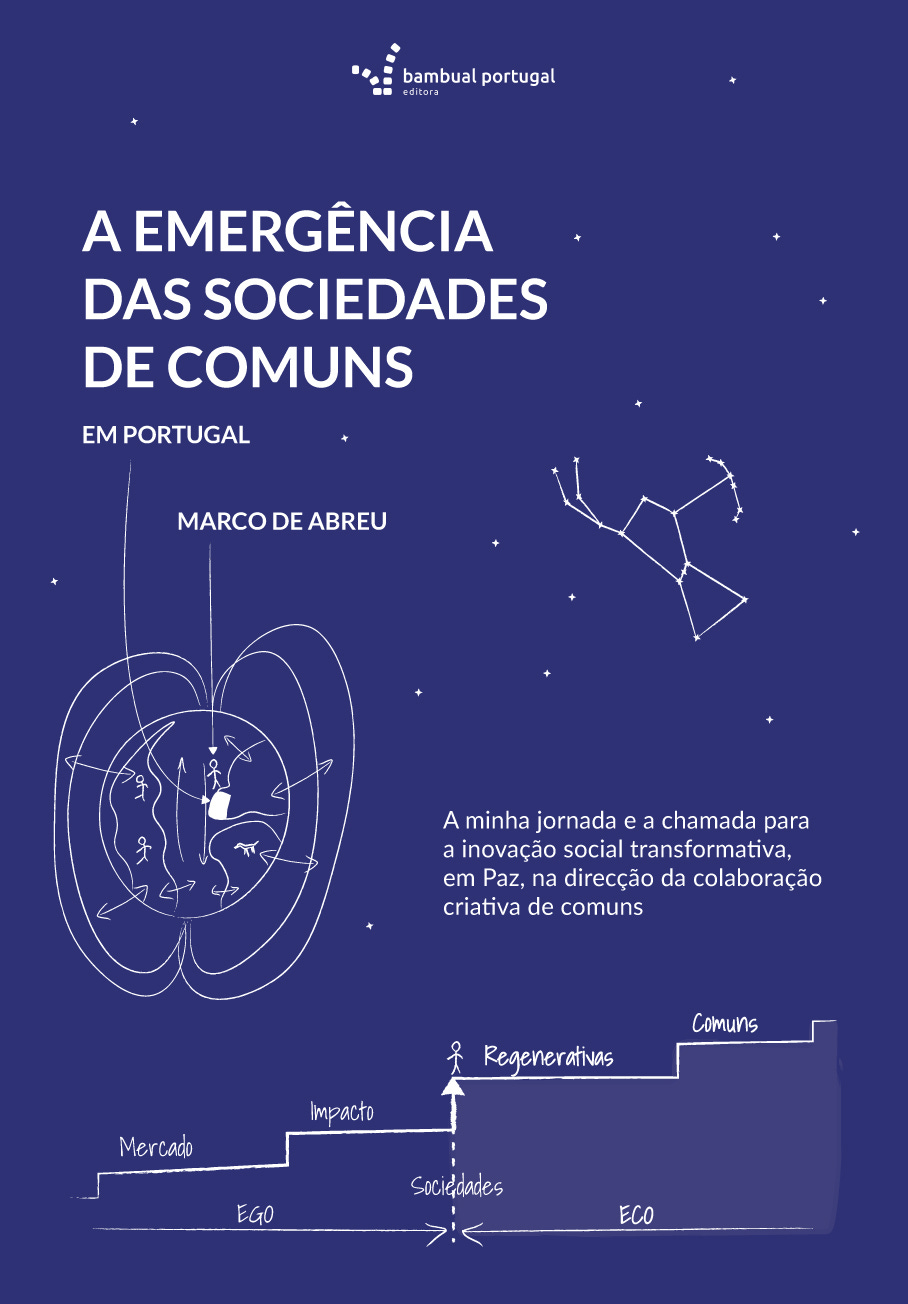
A Emergência das Sociedades de Comuns
The Emergence of Commons Societies
(the english version is been produced)
Thematic field
Maybe on 5: “Supporting grassroots resistance…”.
This book is about memetic structures and in that sense is common to all subjects as he lays bellow, he informs the memes operating
Abstract
The Emergence of Commons Societies explores the theoretical, methodological, and experiential basis for a societal transition toward regenerative and commons-based paradigms. Drawing from live systems thinking, transformative social innovation, regenerative development, and integral theory, the author Marco de Abreu blends autobiographical narrative with a transformative framework that links personal development with awareness based collective action. The book is structured in three volumes that interweave individual journey, conceptual mapping, and sociopolitical application, using Portugal as a living laboratory.
The theoretical approach is deeply interdisciplinary, integrating regenerative systems (inspired by Otto Scharmer, Possibility Management, Regenerative Development, Teoria Integral), cultural evolution, and commons-based perspectives. Methodologically, the work embraces an inquiry-based and transdisciplinary stance, informed by lived experience and action-research and design-research principles. It uses “gameworlds” as a meta-concept for understanding social systems — i.e., the implicit structures through which societies assign value, organize meaning, and enable participation.
The main argument is that societies must shift from exploitative, centralized models (EGO paradigm) to regenerative, commons-oriented ecosystems (ECO paradigm). This shift involves transforming our consciousness (multidimensional), reconfiguring property and economic structures, and cultivating team-based, decentralized governance. The book proposes a model of “Commons Societies” (ECO 2.0) that reimagines institutions, organizations, and communities as co-creative, evolutionary systems aligned with planetary well-being.
In conclusion, the work offers both a critique of current socio-economic paradigms and a hopeful vision for co-created futures. It invites readers to engage in experimentation, inner development, and collective prototyping. For researchers, it contributes to the emerging field of regenerative social theory. For activists, it provides tools for community-building and cultural hacking. For policymakers, it proposes an alternative development path rooted in Portugal’s historical relationship with the commons, suggesting that national identity can serve as a springboard for global innovation toward a post-capitalist society. How can we reimagine and recreate societies that care for Individual Well-being, Collective Well-being, the Well-being of Life and of the Earth, in Peace?